Monday, December 15, 2014

Day 9: Monday, 15 December

Tonight we're staying at a 4-star hotel called "Standesh the Prince" in Mysore which is roughly a three hour drive southwest of Bangalore. Along the way we passed rock outcrops that looked like parts of Arizona. We also crossed through lush agricultural areas growing rice and sugar cane.


View from the front row of the coach
We left Monday morning for the city of Mysore, also in the state of Karnataca. It's roughly a 90 mile drive southwest along the Bangalore-Mysore highway but takes at least three hours because of the traffic congestion in Bangalore. After you leave the city, the landscape starts rolling at becomes very lush. There are a number of rivers that cross through allowing for quite a bit of farming which is predominantly sugar cane and rice. We also passed by an area that looks a lot like the city of Phoenix with its large rock outcroppings. Below is a picture of one of the many welcome signs we saw as we entered different towns. If you enlarge the picture you'll see that the extremely long name of the town.
 We got off the main road and drove onto an island that at one time was the town of a sultan. In 1799, the British overtook the town and claimed it for their own. There were many ruins including the old moats outside the city walls that would have contained crocodiles to deter any unwanted visitors. Below is a picture of some young children we passed while driving through the town.

Mysore is much smaller than Bangalore and is very lush. There is a colonial feel to the town and it's more approachable - easier to get around. Below are photos from the Gandhi Square area, including one from a rooftop restaurant.


Thoughts on the day (from Alison). Mysore is sometimes referred to as the city of palaces. Below is a zoomed-in photo of one of the palaces. 

 Following lunch at our hotel, "Sandesh, The Prince" we drove to the top of Chamundi Hills. The drive was several miles up (and up) a two-laned road with hairpin turns, which, due to the fearlessness of our bus driver, was kind of an experience of its own.   

The Chamundeshwari Temple is at the top of the hill. Our guide explained that the tower of the temple was built in the 17th century, much later than the original shrine. Chamundeshwari is a form of a Hindu god and the temple was built and visited in reverence to him. This golden temple is about seven stories tall and is covered with impressive, ornate carvings.

The crest of the hill included not only a temple, but many tourists, lots of shopping,

and ....monkeys. We were warned by our tour guide to watch out for the monkeys but I didn’t take it too seriously until our group got close enough to the temple to see several of them climbing around on the carvings and decorations. A few of the locals were feeding them but otherwise seemed uninterested. Meanwhile, our group of forty-ish Westerners was furiously snapping photos.


After getting over the monkeys, the temple itself was extremely impressive. Today, there is a path of 1,000 steps up to the temple. Instead of taking the bus, we walked down these steps and caught some beautiful views of the city of Mysore from up above.

 This is a picture of Pramod, our guide for the two weeks.

Sunday, December 14, 2014

Day 8: Sunday, 14 December

Bangaluru sightseeing

Below is a shot with the WMU flag of our entire group that includes 17 students from Griffith University in Brisbane, Australia. We're on a granite hillock in Bangalore's botanical garden.
Overview of the day (from Patrick)

Today, we continued sightseeing the city of Bangalore. It started off with a walk through the beautiful Lalbagh Botanical Garden, a historic pride of the city. This was followed by visiting two Hindu temples that were quite different from each other.

The Bull Temple housed a massive Stone Bull that was nothing short of holy. It was a quick walk through compared to the Krishna Consciousness society, which was three stories tall and contained 3 temples covered in gold that were dedicated to Lord Krishna.

The day ended with exploring Commercial Road, a neighborhood full of street shops and stands. The Haworth College of Business student’s negotiation skills were put to the test while bartering with the workers.

Overall, the day was very eye opening, and introduced us students to some of the Hindu practices. Hinduism is definitely prominent everywhere in India and plays an important role in their culture. The day was definitely another exciting adventure in the city. 


Visit to the Krishna Temple (by Kat)
Today we visited a temple where the monks also work on providing food to 1.3 million underprivileged children across India. It's cool to see their goal of 5 million children set for 2020 regardless of their religious beliefs. The monk giving us the tour reminded everyone that true happiness comes from within and not from external assurances of fame or fortune.


(From the "blogmaster") I like the picture below that includes a selfie in the background of Sheree and Audrey. We're glad to see that Kat is up and about today after a rough day of food poisoning.


Saturday, December 13, 2014

Day 7: Saturday, 13 December

View from the front row of the coach
 I've shown plenty of pictures of the horrendous traffic in Bangalore. Today we left town on one of the few highways which happens to be a toll road. Traveling was much easier on the highway and pretty inexpensive too. The fare at this plaza was Rs16 for a car. At $1 =60 rupees, the toll was only about a quarter.

 We don't see much selling going on in the street (and begging is a crime in the state of Karnataka where Bangalore is located) but the merchants were out today. This one is selling guava.
Today was our first day of having people "unwell." The combination of an intense schedule, foreign food, and recovering jet lag tends to hit people at the end of the first week. Fortunately, everyone seems to be on the mend now.

We spent the day in a rural village in an area east of Bangalore called Hoskote. The cityscape changed as we moved away from the heart of the city. In place of dense housing, the area became much more open but it was dotted with high rises under construction having billboards advertising 3 and 4 bedroom apartments and penthouses. Bangalore is growing at 1 km per day from it's perimeter. That kind of growth is astounding but explains why we spend half our day in traffic.

We left the main road and onto a narrow strip of pavement that twisted and curved through farmland and small enclaves of houses. Relatively small plots of land relied on drip irrigation to grow potatoes (see pictures below), tomatoes, grapes, carrots, and eucalyptus groves. We've heard repeatedly that we're not seeing the "real India." I've come to realize that sometimes that means we're being exposed to the wealthy side of the country including high-end shopping, meals in nice restaurants, and our base camp at Christ University; one of the best in India. Other times, however, it means we're spending all our time in the city and the real India lies in its villages which still comprise 70% of the country's population and are the source of all it's traditions and values. If so, today we saw the real India.


Reflection on the day:  Namaste my friends! (from Genelle)
As I try to summarize today I am lost for words. I believe the best word that describes how I feel is empowered. We visited a small farming community called Hosekote Village and learned about a program that Christ University started in 2003  called Chetana. The Chetana project has been self sustaining for the past 4 years. While we were here we were given a chance to speak to the woman who supervises all of the self help groups for the community.

We also played duck, duck, goose with the children that attend the government school. Lastly, we had an amazing conversation with some women involved in one of the self-help groups and visited a few homes. Since this is a farming community, it was different then the slums of Janakiramnagar and not as heavily populated. There were oxen, we were able to see some harvesting of potatoes and the community was not as crowded. I believe this community is doing very well and I will continue to thrive on the future.

Friday, December 12, 2014

Day 6: Friday, 12 December

Foodie Delight
I'll let others blog about tonight's experience at the Department of Hotel Management. It's enough for now to say the food WE made (well, "helped make") was amazing. Many thanks to the staff at DHM.

Update on the day (From Karen)
Today we started off our day in a session on emerging trends in business and social work. We had the opportunity to observe the different lecture styles of professors from Christ University, Griffith University, and our very own professor, Dr. Palmer. This session was a great way to wrap up our first week here in India.

This evening the Hotel Management professors and students hosted an Indian cooking class and dinner. We were introduced to Lifestyle cooking where we were divided into groups of four and cooked various dishes. My group was in charge of dessert and the dish we made was called semiya payassum, which is a vermicelli pudding. The appetizer was onion pakoda (onion and spices deep fried in graham flour paste that was served with a lime chutney), roast lamb chops (no beef in India!), chicken masala (broiler chicken cooked with tomato and onion gravy), brinjal (eggplant) and potato curry, and coconut pulao (rice).

One interesting thing we learned is that curry is a generic label applied to "sauce" and its flavor depends on what vegetables are used to make the curry. For example, a common curry is made with tomato and garlic. After all the dishes were cooked we all sat down and ate our delicious creations with our instructors (below).


Sheree's Birthday
It's not every year you celebrate your birthday in a foreign country! Today roughly 70 people including students from WMU and Griffith as well as Christ University Masters in Social Work students sang happy birthday. It's a universal song. Below is Sheree and the cake that was served before making dinner.

Thursday, December 11, 2014

Day 5: Thursday, 11 December


View from the front row of the coach
Our driver is amazing. You may think you know traffic but unless you've driven in India you can't know its full potential. No roads in Bangalore go straight and getting places often requires U-turns in the most unlikely places. Our driver has no fear and he always seems to know where he's going. Well, mostly!
Below is a night scene heading home from MG Road (the road is called "MG" which is an abbreviation for Mahatma Gandhi).

Your fearless leaders. Steven Larmar and Pat Dorsett from Griffith University are on the left. Tim and Louann Palmer (WMU) are on the right.

Janakiramnagar Community (by Ryan)
Our day started off at a business conference here at Christ University. The focus was on emerging business trends and it was very informative and sort of re-instilled a lot of the things we talk about in HCOB.

In the afternoon, we took a trip to a slum in Bangalore and that was definitely something that will forever be burned into my memory. A "slum" is an official designation, defined by the UN as an area that is technically uninhabitable because it lacks necessary infrastructure like drainage, water, and toilets. The conditions that the people there have to endure are mind boggling and really made all of us appreciate how fortunate we are.

We learned specifically about self-help groups that women are a part of that allow the women to look out for one another and encourage each other to keep advancing. Specifically, there was a self-help group called Second Hand Shop where women take materials that we would otherwise consider as garbage and use these materials to make all sorts of amazing and practical items. After that eye-opening experience, we were taken to a really modern mall where we shopped and had dinner. Needless to say, it was a packed and fulfilling day.

Janakiramnagar Community (by Chelsea)
I love how much the women in India work together to build and thrive within their communities. They use things we consider "trash" and turn them into beautiful purses, wallets, iPad covers, and much more! For them to start as a small Self Help Group and transform into their own independent business is so rewarding.

Janakiramnagar Community (by Tamara)
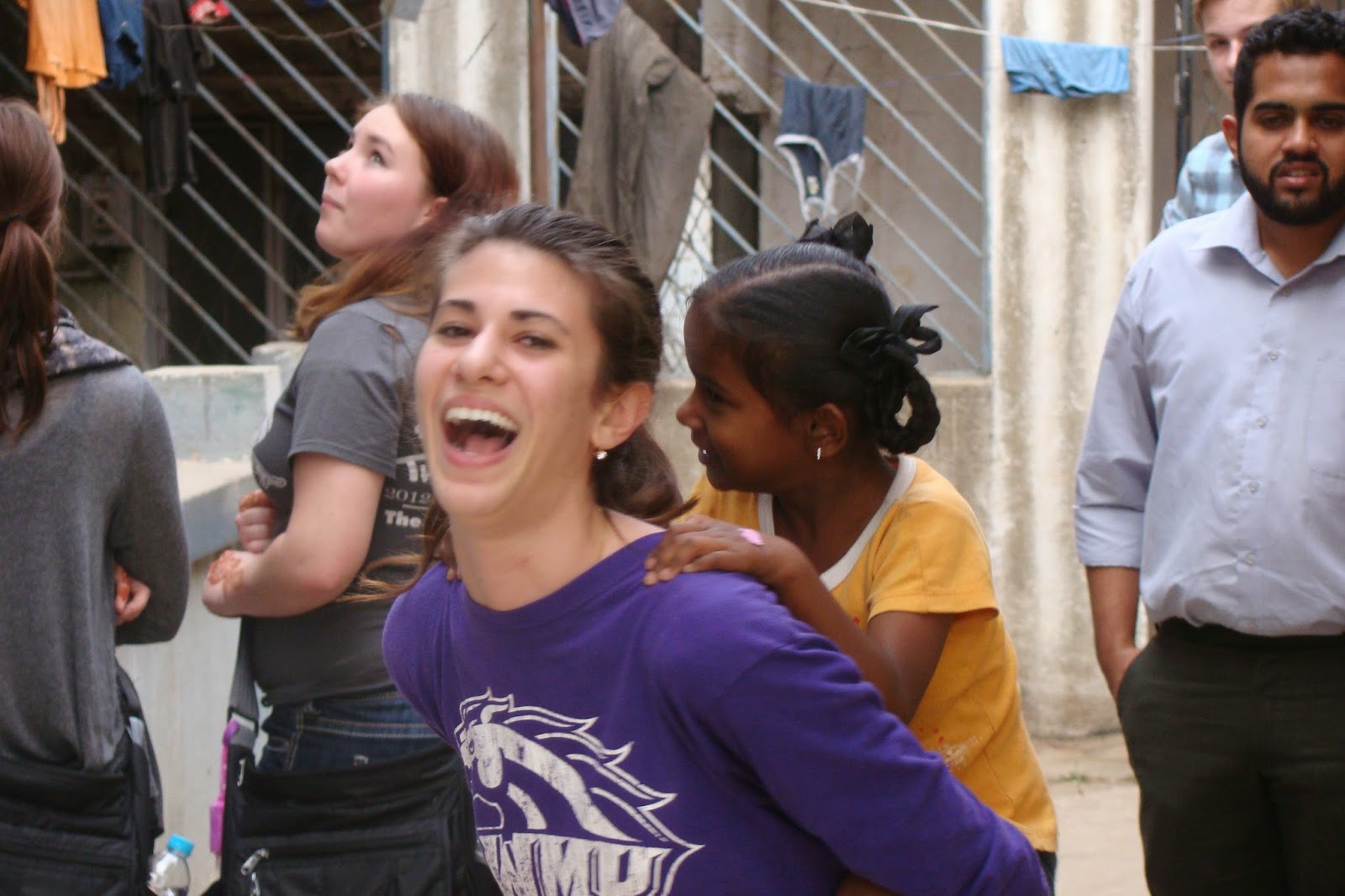
It's hard to believe that I've already been in India for five days now! Today we had the opportunity to visit the Janakiramnagar community, which is a slum located in Bangalore. Christ University has a great influence within this area of Bangalore. One of the projects within this slum area that they help support is the 3D Empowerment project.

This project focuses around the women and children that live in the Janakiramnagar slum area. Various students from Christ University sponsor youth within the community by providing them with resources that are needed to further their education. In addition to the financial support, they act as mentors to the children. Students will take the time to visit the slum community that their paired student lives in.

For me having the first hand experience within the slum community and seeing the various development projects put in place was the most impactful part of my India trip thus far.

Wednesday, December 10, 2014

Day 4: Wednesday, 10 December

View from the front row of the coach
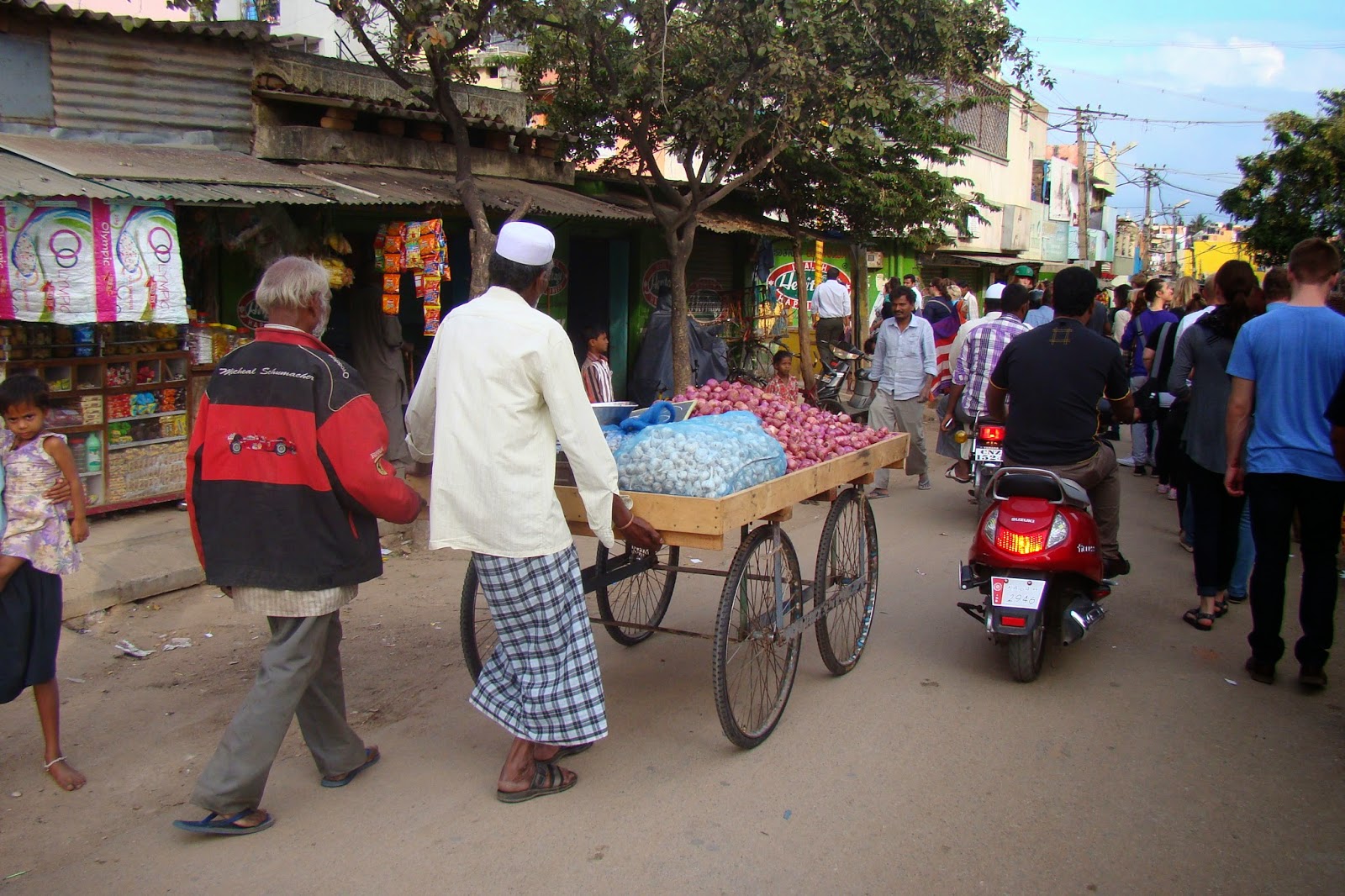
In addition to the site visits and cultural activities, there is much to learned about India as an emerging economy from the front seat of the bus. Always, there is a blend of the old and the new. Below are street scenes that give you a sense of what we are seeing.

Bosco Mane (blogged by Audrey)
Today we visited Bosco Mane, a school for young at risk, started by priests of the order of St. John Bosco, an Italian priest who is known for his work of educating the poor. We heard a lot of staggering statistics from the chair manager who gave a very good presentation. We learned about the Juvenile justice act, and about how the system works in India. Every day, 70-90 children come to Bangalore unaccompanied. They may be there by mistake or because their family cannot take care of them. Operating in the major transportation centers, social workers identify the children at risk and take them to the drop in center, where they are given the care they need. The first step is always to notify the family of the child that they are safe. Then it is decided if home placement is appropriate. This is similar to the idea of reunification in the US, what it is always an effort to return children to their family unit.

If that is not possible, then the children are taken to a school where they are fed, clothed, and housed. We were shown a room that was described as "multi-purpose" where the children eat, have some classroom activities, and also sleep on mattress pads that are moved to the side every morning.

When we meet the children, they were all very excited. The Australian students brought bubbles, which of course turned into a very rambunctious competition to see who could pop the most bubbles. Then the children took around notebooks where they wanted us all to sign our names. A dance and song presentation followed, which was very enthusiastic. Music and dance is a very large part of the culture here, and it is great to see children excited about sharing that with us.

IGP'ers from WMU


And new friends from Griffith University in Australia